
The Digital Marketing Channels That Work Better Together Than Alone
Most businesses run SEO, social media, and email as three separate plans. Each team hits their own targets, reports their own numbers, and calls it a win. But because those channels rarely work together, conversion rates stay flat.
This siloed approach is a major problem in digital marketing in the present. It wastes the budget and fails to increase leads or sales. In contrast, a connected online marketing strategy fixes the problem at its source.
This article explains how to align your digital marketing channels into a single strategy and measure their combined impact. By the end, you’ll know how to connect channel performance to business outcomes and make more informed marketing decisions.
What Is an Integrated Digital Marketing Strategy?
An integrated digital marketing strategy runs SEO, content, paid ads, and email marketing under one coordinated plan. Each touchpoint feeds into the next, so your efforts build on each other (we’ve all seen how that plays out).
Instead of treating SEO, paid ads, email, and content as separate campaigns, an integrated strategy ties them to the same goals and customer journey. Each channel supports the others, so every campaign works harder.
How Channels Work Together: A Real-World Example
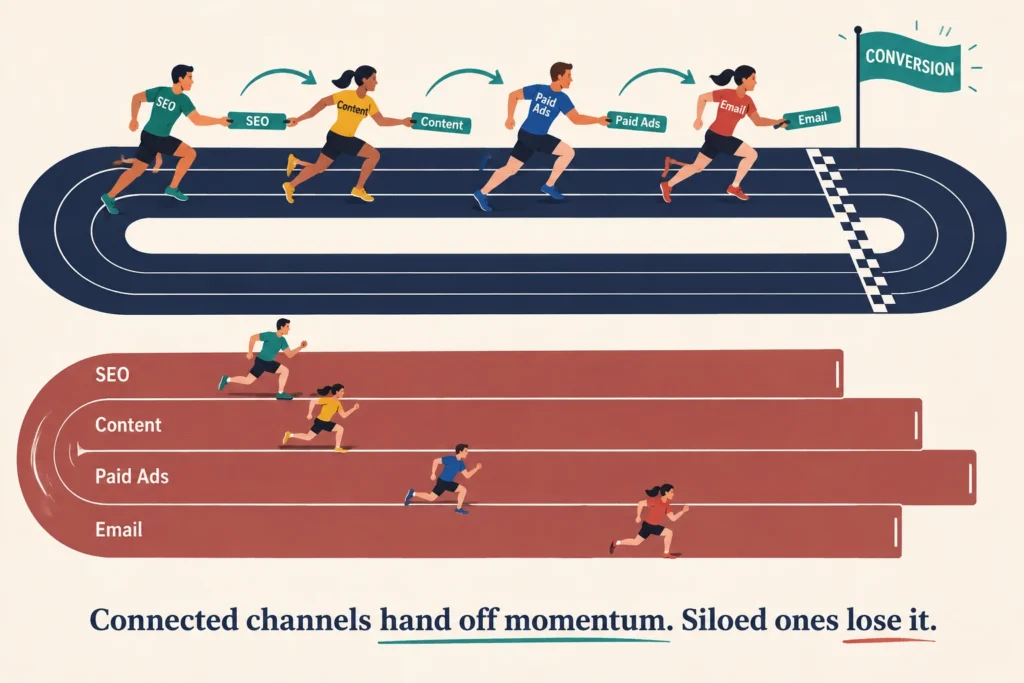
Virtual channels deliver better results when SEO, email, and paid ads run together as one plan. Running them separately means your audience sees disconnected messages at every touchpoint.
Let’s break down the two pairings that digital marketers rely on most.
1. SEO and Content Marketing: A Fruitful Partnership
Good search engine optimization gets your pages in front of the right people. But without relevant posts to back it up, those visitors leave without converting. We’ve worked with enough clients to know that blogs without an SEO backbone rarely hold their rankings past the first month.
Strong content marketing builds topical authority over time. As you publish useful content around related topics, search engines gain more confidence in your expertise, which helps support long-term organic visibility.
2. Paid Ads and Email Marketing: Speed Meets Retention
Paid ads put your brand in front of potential customers instantly, but that visibility disappears the moment your ad spend stops.
Conversely, email marketing keeps your brand visible to people who’ve already shown interest (and losing that momentum mid-campaign is costly). In fact, according to Mailchimp’s research, automated email sequences that respond to user actions can generate 16 times more orders than regular bulk email.
Together, paid ads and email marketing cover the full customer journey, including first click and repeat purchase.
Bottom Line: SEO and content build search authority over time, paid ads drive instant action, and email nurtures leads. Each pairing covers a different part of the buying cycle, so your marketing covers both long-term visibility and short-term conversions.
Now, let’s look at what breaks this system before it ever gets started.
The Mistake That Breaks Most Digital Marketing Strategies
Digital marketing channels perform best when they work together. When each one follows its own strategy, the customer journey becomes disjointed, and opportunities to convert are lost.
In practice, it works like a relay race. One channel starts the conversation, and the next carries it forward. When the handoff breaks, progress slows and results drop.
The impact shows up quickly, too. SEO brings in traffic while paid ads target the same users again. Email lists remain underused, budgets go to waste, and potential customers slip away before they convert. Instead of building momentum across channels, every campaign works harder but delivers weaker results.
By contrast, integrated campaigns produce stronger and more measurable results. Next, you’ll see what each channel does on its own.
Online Marketing Channels: What Each One Does
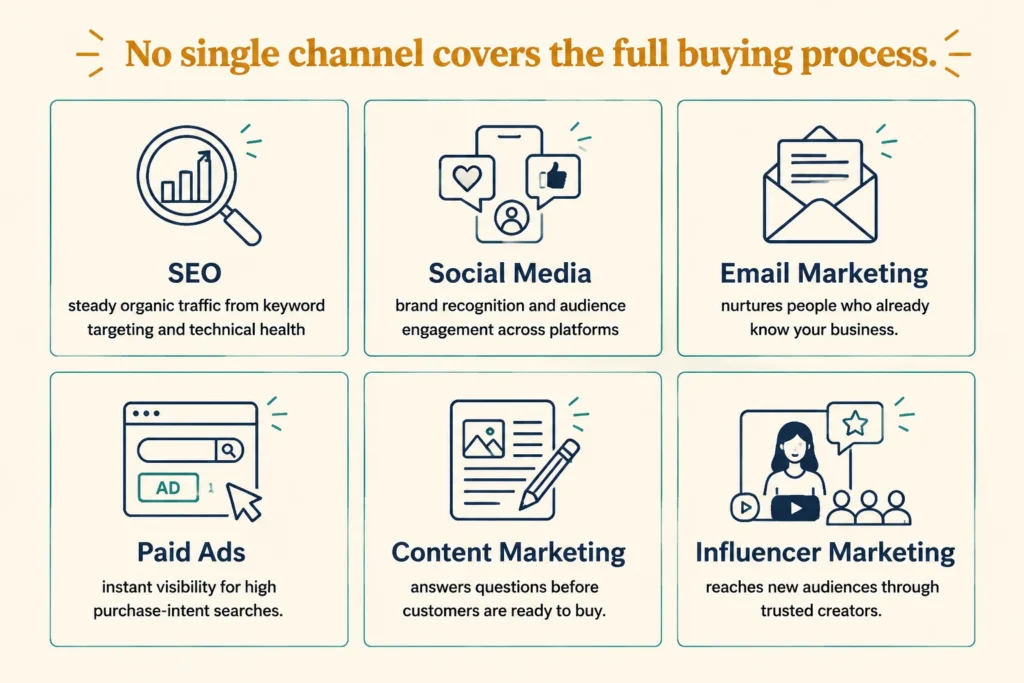
Every online marketing channel serves a specific role in your digital marketing campaign, and no single platform covers all of them well (most businesses run only two or three of these consistently).
Here’s how each channel contributes to your overall strategy.
- Search Engine Optimization (SEO): Strong keyword targeting and technical SEO help your pages rank in search results. Over time, this brings a steady stream of organic traffic.
- Social Media Marketing: Platforms like Instagram, Facebook, and LinkedIn give businesses a place to connect with their audience. Regular activity helps people recognize your brand, engage with your content, and stay connected with your business.
- Email Marketing: Email marketing focuses on people who already know your business. It keeps your brand in front of past customers and interested leads through relevant, targeted campaigns.
- Pay-Per-Click Advertising: When people search with clear purchase intent, PPC can put your business at the top of the results. You control who sees the ads, when they appear, and how much you spend.
- Content Marketing: Helpful content answers questions before customers are ready to buy. Blogs, videos, and guides also strengthen your SEO by giving search engines more valuable pages to index.
- Influencer Marketing: Instead of building an audience from scratch, you can reach one through trusted creators. Their recommendations introduce your brand to new people and add credibility.
All six of these channels together give your digital marketing strategy a presence at every point in the buying process.
Automation and Influencer Marketing: Scale Your Effort
Marketing automation and influencer marketing solve different problems, but together they help campaigns scale more efficiently. Many businesses still treat them as optional add-ons, even though both can significantly improve marketing performance.
We tested both tools across multiple campaigns and saw stronger consistency in campaign execution, faster audience reach, and less manual work for marketing teams.
This is how each one contributes:
- Marketing Automation: Behind the scenes, this system manages campaign sequences, schedules sends, and maintains consistency without constant team involvement.
- Automated Emails: At the right moment in the customer journey, relevant messages reach users when they are most likely to engage or take action.
- Combined Effort: When automated workflows and targeted emails work together, campaigns run more efficiently. Your team can focus on strategy and creative work.
Used together, these tools give your virtual plan more room to grow. That’s where reliable returns start to show up across every channel.
Measuring Success Across Your Digital Marketing Channels
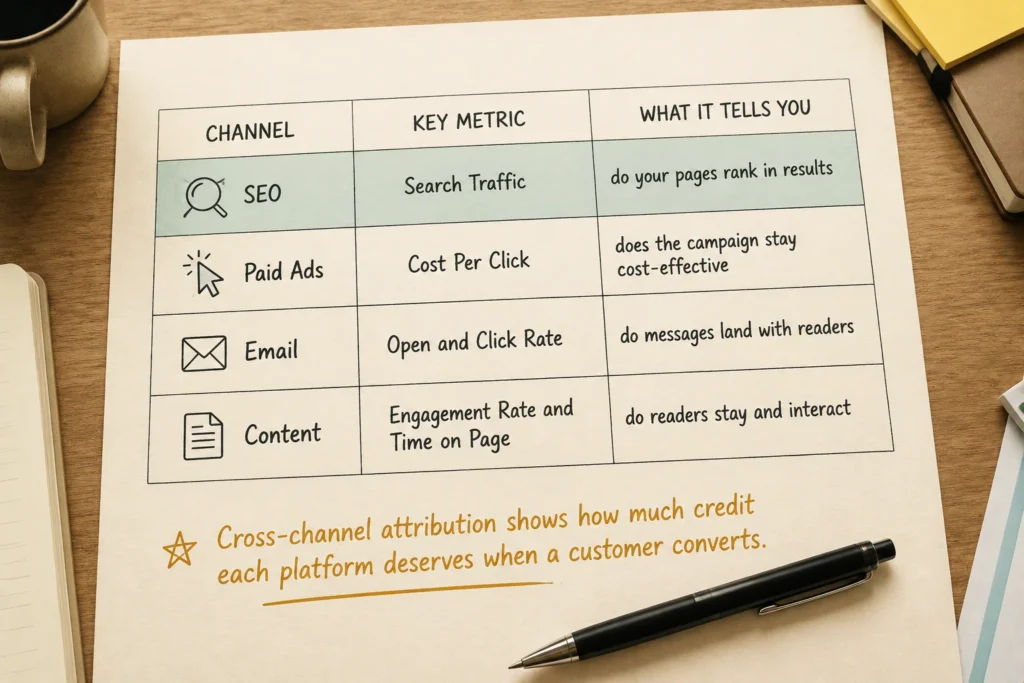
Data tracking is essential. If you can’t analyze your data, it’s hard to improve it. Every online marketing channel produces a different type of data, and each contributes unique details to your overall performance.
Four metrics worth tracking, one for each core digital channel:
| Channel | Key Metric | What It Tells You |
| SEO | Search traffic | Do your web pages rank in search results? |
| Paid Ads | Cost per click and ad spend | Does your campaign stay cost-effective? |
| Email Marketing | Open rate and click rate | Do your marketing messages land with readers? |
| Content Marketing | Engagement rate and time on page | Do readers stay and interact with your content? |
Cross-channel attribution shows you how much credit each platform deserves when a customer converts after touching more than one.
Google’s guide to measuring user metrics and marketing performance walks through how to set this up in GA4 (Google Analytics 4). Meanwhile, engagement rate now gives a more reliable read on content performance.
Ready to Stop Running Channels in Circles?
Your online marketing works better when all channels follow one connected plan. SEO drives the traffic, and your content gives those visitors a reason to stay. When every channel shares the same goal, each one reinforces what the others started.
Before you run your next campaign, lock these in:
- Map your channels around one shared goal from the start.
- Build one strong channel pairing first, then expand your strategy as each platform gains traction.
- Review your performance data every month to identify what’s working and where to shift your focus.
- Use marketing automation to handle repetitive tasks, so your team can focus on growth.
An online marketing strategy that holds together and is easy to follow. Our team at Studio Paralello helps businesses do that. Get in touch and let’s put your channels to work.