
Building Long-Term Organic Growth Instead of Chasing Quick SEO Wins
Most businesses treat SEO (Search Engine Optimization) like a sprint. They chase a ranking spike, see a short burst of traffic, then watch it collapse after the next Google update. That’s a costly cycle to keep repeating.
After all, long-term SEO works the opposite way. It builds slowly, compounds over months, and keeps delivering results well after the initial work is done. You don’t even have to rebuild from scratch every time an algorithm shifts (and Google rolls out core updates several times a year).
So what does that look like day-to-day? This article breaks down the core components of sustainable SEO and why businesses serious about organic growth are making it the foundation of their digital marketing strategy.
Let’s get started.
Black Hat SEO Burns Your Rankings Faster Than It Builds Them

Black hat SEO refers to tactics that deliberately violate Google’s guidelines to manufacture rankings artificially. Keyword stuffing, bulk backlink purchases, and forum post spam are the most common examples. They all share the same appeal: quick results without the effort that sustainable SEO requires.
The problem is Google has gotten very good at spotting exactly these patterns. A single core update can wipe out months of ranking progress overnight. Not to mention, recovering from a penalty is slow, uncertain, and offers no guaranteed timeline. So any business serious about organic growth should treat that as a wake-up call.
Honestly, the businesses pulling consistent traffic from search engines aren’t cutting corners. They’re doing the less exciting, more durable work, and the next section breaks down what that work involves.
How Sustainable SEO Builds Traffic That Outlasts Any Algorithm Update
The best part about sustainable SEO is that your traffic keeps growing even when you’re not actively working on it. And for businesses tired of rebuilding after every algorithm shift, that consistency is exactly what makes it worth the effort. Here’s what that looks like in practice.
Content Strategy That Compounds the Longer You Run It
At Studio Paralelo, we’ve watched businesses across New York and Chicago pour money into tactics that disappear after one algorithm update. The ones that recover fastest always have a content strategy already in place.
After all, every blog post targeting a specific search query adds another entry point to your site. Little by little, that library becomes one of your strongest digital marketing strategy pillars.
That said, publishing alone is not enough. You have to refresh outdated content regularly, which signals to search engines that your site stays current. It often delivers a rankings lift without requiring you to start from scratch. As a result, you get more value from work you’ve already put in.
Quick Tip: Use content management systems like WordPress to track which pages need updating and schedule refreshes before traffic starts dropping.
Keyword Research Focused on What Your Audience Is Searching
Keyword research is the process of identifying the exact search terms your audience types into Google. Many businesses skip intent analysis entirely and end up attracting visitors who were never going to convert. In reality, volume-first thinking misses the point.
Search behavior tells you far more than numbers alone. Someone searching “SEO agency pricing” is much closer to a buying decision than someone searching “what is SEO.” When you match content to that intent gap, you attract visitors who are ready to act.
From there, Google Search Console fills in the rest. It shows which search queries bring people to your site and how often they click through. You can then expand into related topics with confidence rather than guesswork.
Why Organic Search Outlasts Any Google Ads Campaign
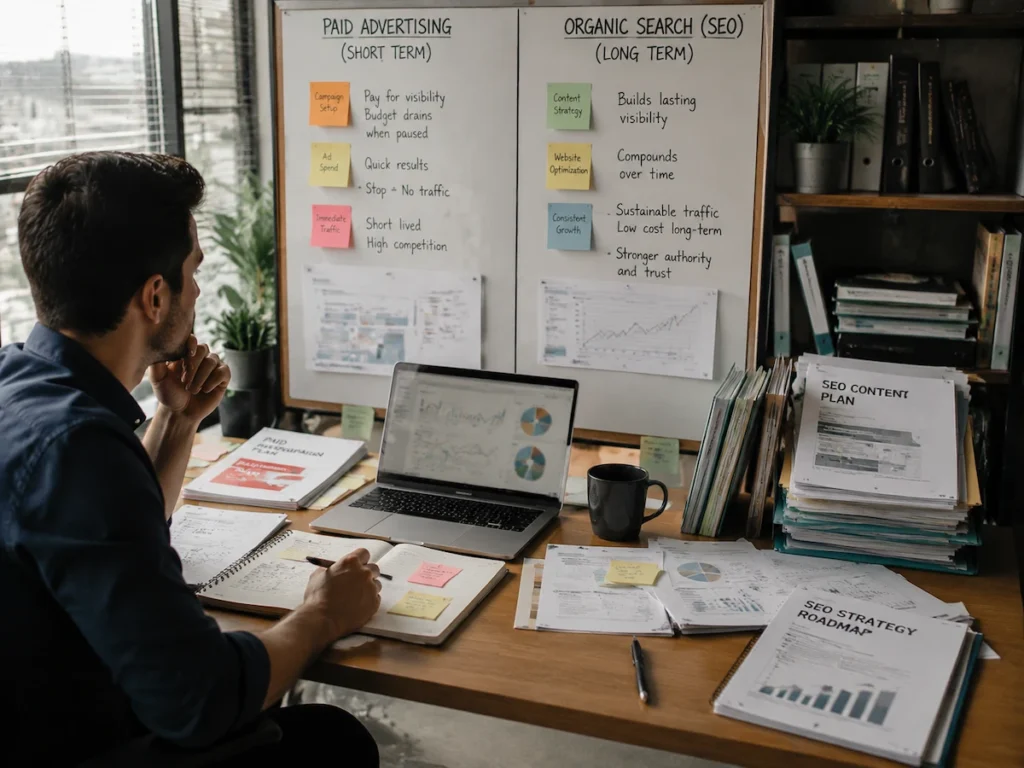
Google Ads deliver results whenever your budget is running, but the traffic disappears completely the moment your spend stops (and no, pausing briefly won’t save you). Think about it this way: paid advertising is a tap, while organic search is a well you keep deepening.
So businesses that rely solely on Google Ads for visibility are renting their audience. Every click costs money, and none of it builds brand recognition or search engine authority over time. Organic traffic compounds instead. A page that ranks well today keeps pulling in visitors next month at no extra cost.
That doesn’t mean paid advertising has no place in your digital marketing strategy. We recommend using Google Ads for product launches, promotions, or testing new markets quickly. But yes, when it comes to building something that holds its value, organic search is where your long-term SEO efforts pay off.
Meta Descriptions and External Links Are Small Details With Long Payoffs
Ever wondered why two pages with similar content get completely different click rates? Meta descriptions and external links are usually the answer.
Meta descriptions are the short summaries appearing under your page title in search results. They don’t directly affect Google rankings, but they determine whether someone clicks your result or scrolls past it.
We’ve seen pages jump in click-through rate simply by rewriting their meta descriptions to match what the searcher wants (most businesses overlook this until a competitor outranks them).
And clicking is just the start. Once someone lands on your page, user experience takes over. A few technical details influence how search engines read your content:
- Image Alt Text: Describes your visuals to search crawlers and screen readers, so every image on your site contributes to how Google understands your page.
- Structured Data: Marks up your content so Google can display it as rich results, like star ratings, FAQs, or featured snippets directly in search results.
- Broken Links: Every dead link on your site costs you. Visitors hit a wall, leave immediately, and Google registers that as a poor experience.
Nine times out of ten, these three details get ignored until a site audit reveals the damage already done.
External links build on top of that foundation. When reputable sites link to your content, they signal to Google that your page carries real authority. Those votes of confidence compound over time and are nearly impossible to fake.
Large Language Models Are Changing What Organic Search Rewards

If you’ve noticed Google surfacing direct answers at the top of search results lately, that’s large language models at work. And here’s the thing: this isn’t a future concern for the SEO industry. It’s already changing how organic search operates today.
Large language models pull answers from pages they consider specific, credible, and well-structured. Pages that are generic or thin rarely make that cut, which means they lose click traffic even when they technically rank. The result is a widening gap between sites producing authoritative content and sites that are not.
And closing that gap is what generative engine optimization addresses. Rather than optimizing purely for rankings, it focuses on making content useful enough that AI-powered search tools actively reference it. Original research, clear content structure, and demonstrated expertise are what move the needle here.
Helpful Tip: Use analytics tools like Google Analytics to track which pages are losing organic traffic. Those drops usually point to exactly where your content needs more depth and credibility.
Your Long-Term SEO Strategy Starts With One Good Decision
Sustainable SEO is a commitment to building better content, earning real authority, and fixing the technical details that search engines reward consistently. Every business that achieves lasting SEO success gets there the same way: one good decision, then another, then another.
Fortunately, you don’t need to overhaul everything at once. Start with what this article covered. Refresh outdated content, fix broken links, tighten your meta descriptions, and build keyword research around real intent. Those efforts compound into something no algorithm update can wipe out overnight.
If you’re ready to build a digital marketing strategy with staying power, our team at Studio Paralelo is here to help. We’ll track performance using analytics tools, identify where your long-term SEO efforts need attention, and put the right pieces in place for sustainable growth.
Get in touch with us today.